

From WhatsApp Enquiry to Booked Appointment: A Practical Workflow for UAE Businesses
Fast replies help, but a reliable WhatsApp workflow must also move an enquiry towards a real outcome without becoming intrusive.
By Vishesh Jain, Cofounder, Nudge
A potential customer messages a training provider in Dubai at 9.30pm: “Hi, is there space in tomorrow’s course?” Nobody is at the office. By morning, the customer may have contacted three other providers.
This is an illustrative example, not a customer case study. It shows a challenge that training providers, property companies, home-service businesses and other appointment-led companies can encounter: an enquiry arrives outside working hours, but there is no clear process for turning it into a confirmed next step.
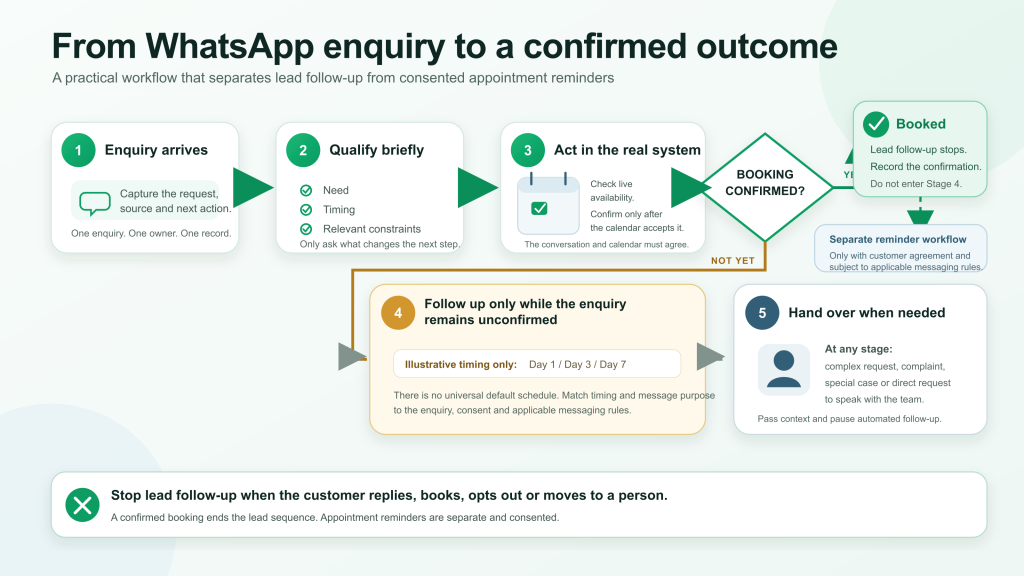
Automation can help when the workflow is designed around the customer’s goal. A polished greeting that leads nowhere is still a dead end. A better system has five stages: capture, qualify, act, follow up and hand over.
1. Capture the enquiry before it disappears
The first job is to create a usable record: the customer’s name, WhatsApp number, enquiry time, requested service, current stage and next action. Record the source too, such as an advertisement or web page.
Keep the stages simple. “New”, “qualified”, “appointment offered”, “booked”, “not ready” and “closed” are more useful than a complicated pipeline nobody maintains. Every open enquiry should have an owner and a next-action time. That prevents two employees replying, or everybody assuming somebody else will follow up.
A scheduled lead follow-up must not continue unchanged after the person has replied, booked, opted out or asked to speak to someone. Cancel the stale message and reassess the next action.
2. Qualify with the fewest useful questions
Qualification should reduce effort for both sides. Ask only what is needed to decide the next step.
In the training-provider example, the workflow might ask which course the customer is interested in, the preferred start date, and whether online or classroom delivery is suitable. Three relevant questions beat a ten-question interrogation. Anything unusual or outside the defined process should go to a person.
This principle works elsewhere. A maintenance company may need the location, problem and urgency. A property company may need the area, budget and preferred viewing time. The questions should change with the service, but the rule stays the same: collect only what is needed to decide the next step.
The customer should also be able to escape the workflow. “Speak to the team” should be a real option, not a button that sends the person into another loop.
3. Take the action in the real system
This is where useful automation differs from an automated FAQ. If the customer wants an appointment, the workflow should check actual availability, offer valid times and write the confirmed booking into the business’s calendar or booking system.
It should never say “booked” merely because the customer selected a time in WhatsApp. Confirmation should happen only after the booking system accepts it. The record should include a reference, branch, date, time and staff member or resource involved, as applicable.
A confirmed booking must stop the earlier lead follow-up sequence. Any later appointment reminder is a separate message and should be sent only where the customer has agreed to receive it, subject to the applicable messaging rules.
The same rule applies elsewhere. A payment request should use the approved payment process. A property viewing should appear in the agent’s calendar. A support request should update the correct case. The conversation and the operating system must agree.
4. Follow up without becoming a nuisance
Not every interested customer books immediately. A useful follow-up adds information or removes friction: “Would you like morning or afternoon?”, “The 4pm slot is still available”, or “Here is the location you asked for.”
Availability claims must be checked before sending. Repeating “Just following up” five times adds neither information nor convenience.
The WhatsApp Business Messaging Policy requires businesses to obtain the recipient’s number or username and opt-in permission for subsequent contact, and to respect opt-outs.
For the WhatsApp Business Platform, businesses can reply without a message template within the 24-hour customer-service window, which opens and resets with each user message. Outside that window, messages must use approved templates. Business-initiated conversations also require approved templates.
Timing is therefore part of workflow design. A later follow-up may need an approved template and appropriate permission. It should identify the business, match what the person agreed to receive and make stopping future messages easy.
A sensible sequence is short. Send the promised information, one relevant reminder where appropriate, and then stop unless the customer responds or has explicitly agreed to further communication. More messages do not automatically create more intent.
5. Hand over at the right moment
Automation should stop when a person can do the job better. Typical handover points include a complaint, a refund dispute, a request for a special price, a sensitive personal question, repeated misunderstanding or a direct request for an employee.
WhatsApp’s policy permits automation when responding within the customer-service window, but requires prompt, clear and direct escalation routes.
Operationally, the employee needs the conversation history, the customer’s answers and the action already attempted. Asking the customer to start again defeats the purpose.
Once an employee takes control, automated lead follow-ups should pause. A confirmed booking, an opt-out, a wrong-number response or any change that makes the original message irrelevant must also stop the stale sequence.
Appointment reminders remain a separate workflow, subject to customer agreement and applicable messaging rules.
The UAE compliance layer
Good workflow design makes compliance easier to operate consistently. Businesses should first identify the data protection framework applicable to their activities: the federal law contains exclusions, including for free zones with their own personal data protection legislation.
For businesses within its scope, the UAE’s Personal Data Protection Law generally requires consent for processing unless an exception applies. It also establishes principles covering a specific purpose, collecting only necessary data, accuracy, security and retention limited to what is needed.
Businesses should decide why each WhatsApp field is collected, who can access it, how long it is kept and how a person can exercise their rights.
Marketing messages need separate care. Cabinet Resolution No. 56 of 2024 includes marketing texts and marketing messages through social-media applications within its definition of telemarketing. It also provides consumer protections and a Do Not Contact Register framework.
A booking confirmation requested by a customer serves a different purpose from an unsolicited promotion. Classify each message by its actual content and purpose.
Check current requirements with the relevant UAE authority or qualified advisers, particularly for promotions, sensitive information or activities subject to additional rules.
A practical implementation checklist
Before switching on an automated WhatsApp workflow, test these questions:
- Does every enquiry create one record with an owner, stage and next action?
- Are qualification questions limited to what is genuinely needed?
- Does a booking become confirmed only after the real booking system accepts it?
- Can the customer reach a person easily?
- Do replies, bookings, opt-outs and human takeovers cancel stale follow-ups?
- Is subsequent business-initiated contact supported by the appropriate opt-in and, where required, an approved template?
- Are you collecting the minimum personal data and protecting access to it?
- Can the team explain why each message is being sent?
- Have you tested wrong numbers, unavailable slots, duplicate enquiries and staff takeover?
The goal is to make sure a genuine enquiry reaches a useful outcome, with fewer gaps for the customer and fewer loose ends for the team.
About the author
Vishesh Jain is the cofounder of Nudge, an AI Front Desk that helps service businesses qualify leads, book appointments and manage follow-ups through WhatsApp.