UAE Property Outlook 2027: What Buyers Should Watch Beyond Off-Plan Sales
Louis Harding, Partner, Head of UAE Residential at Knight Frank, discusses why completed supply, borrowing costs and property-level returns deserve close attention as buyers assess the year ahead.

Off-plan sales remain a substantial part of Dubai’s residential property market. For buyers looking towards 2027, however, the more useful question is how new developments will perform when they become completed homes competing for residents, tenants and resale buyers.
In written responses to UAE-Business.com, Louis Harding, Partner, Head of UAE Residential at Knight Frank, describes a market becoming more diverse across locations, property types and buyer requirements.
His outlook centres on differentiation: the arrival of additional homes may create pressure in some locations, while other properties retain stronger demand. That assessment is a market view, rather than a forecast of uniform price growth or decline.
Off-plan and secondary sales measure different things
Knight Frank’s Research team supplied UAE-Business.com with updated figures showing 81,926 residential transactions in Dubai during the first half of 2026, with a total sales value of AED 226.2 billion.
The team said these additional H1 figures came from internal research data not yet published in a standalone report.
Its clarification also distinguishes two separate classifications of residential sales:
| Classification | Share of H1 2026 residential transactions by number |
|---|---|
| Off-plan / ready | Approximately 74% / 26% |
| Primary / secondary | Approximately 72% / 28% |
The pairs should be read separately. In particular, the secondary-market share is not the remainder after subtracting off-plan transactions.
These figures describe residential sales activity. They do not measure the division of demand between purchasing and renting, because leasing transactions are outside the stated sales base.
For Harding, the next stage of development will become clearer as previously sold homes reach completion.
“As more off-plan homes complete, some will become owner-occupied, while others will enter the leasing or secondary sales markets,” he said.
That process could increase choice, but its effects will depend on where homes are delivered and the demand they attract.
Completed supply matters more than announced supply
Harding identifies actual completions as a more useful indicator than headline development pipelines.
A scheduled handover is a future milestone. Its effect on the market depends on delivery timing, the surrounding stock and whether owners occupy, rent or sell their homes.
“Where large volumes of similar stock complete within the same location and price bracket, buyers and tenants should have greater choice, which will likely put pressure on pricing,” he said.
His assessment suggests that buyers should examine competing supply at the community and property-type level, alongside the developer’s delivery record and the project’s expected completion.
“The biggest mistake is treating every off-plan opportunity as interchangeable.”
Harding also highlights payment structures, service charges and realistic rental expectations. A project’s performance after handover will provide a different test from its initial sales success.
Luxury transactions do not describe the whole market
Knight Frank’s public analysis dated 6 July 2026 recorded 296 Dubai home sales above US$10 million during H1, with a combined value of US$5.1 billion.
The same publication also reported price softening in parts of the mainstream market. It cited location-dependent declines of between 5% and 20% and noted that some recorded luxury transactions reflected agreements reached before the regional conflict, with registration following later.
Those observations are dated July commentary, rather than an October price assessment or a single city-wide price index. They nevertheless show why transaction totals, luxury demand and mainstream affordability need to be assessed separately.
Harding cautions against assuming that the rate of price growth seen in recent years will continue indefinitely.
His identified risks include a faster-than-expected increase in completed supply, weaker global economic conditions, geopolitical disruption and changes in international wealth flows.
Affordability and returns require different calculations
For buyers using a mortgage, Harding describes affordability as a combination of the purchase price, deposit and monthly borrowing cost.
Changes in financing conditions therefore influence purchasing budgets, alongside household income, rents and the cost of remaining a tenant.
For rental investors, he argues that headline yield alone is insufficient.
“Two properties offering the same headline yield can therefore produce very different actual returns,” he said.
Service charges, maintenance, vacancy and management costs affect rental income retained by the owner. Financing affects cash flow, while acquisition costs influence the overall investment calculation.
These considerations also reinforce the importance of property-specific assumptions. An advertised rent or a market-wide yield estimate cannot establish what a particular home will earn after costs.
This interview does not provide a verified schedule of current rental yields or a numerical forecast for 2027.
The UAE is more than one residential market
Harding sees Abu Dhabi and Ras Al Khaimah developing distinct residential propositions, with different demand drivers.
Knight Frank’s public Abu Dhabi review, published on 22 July, reported apartment price increases of approximately 18% on Yas Island and Al Reem Island in the year to June 2026. The same review showed more varied villa performance, illustrating why results for one property type should not be applied to another.
Harding associates Ras Al Khaimah’s development more closely with tourism, resorts and international connectivity, particularly around Al Marjan Island. This is his assessment of its demand drivers, rather than a quantified forecast of future returns.
Across the UAE, he also sees a changing relationship between residential property and relocation, with some buyers moving businesses, families and wealth to the country.
That observation should be distinguished from a measured breakdown of completed purchases by nationality.
What to monitor during 2027
Harding’s watch list includes actual completions, off-plan and secondary-market activity, rental growth, mortgage activity and the absorption of new launches.
Population and wealth migration also matter in his assessment because sustained residential demand depends on people choosing to live, work and invest in the country.
At the individual development level, he highlights resale activity after completion as a useful test of lasting demand.
For buyers comparing opportunities, these indicators offer a framework for examining a particular property: its competing supply, likely occupiers, financing requirements and ongoing costs.
The evidence to watch during 2027 will therefore extend beyond launch announcements and aggregate sales totals to how completed homes perform in everyday use.
This article draws on written responses supplied by Knight Frank on 8 October 2026, Research team clarifications received on 19 October, and the dated public publications linked below. Forward-looking assessments represent Louis Harding’s views.
Public sources
- Knight Frank: Dubai US$10 million-plus residential sales analysis, 6 July 2026
- Knight Frank: Abu Dhabi residential and office market update, 22 July 2026
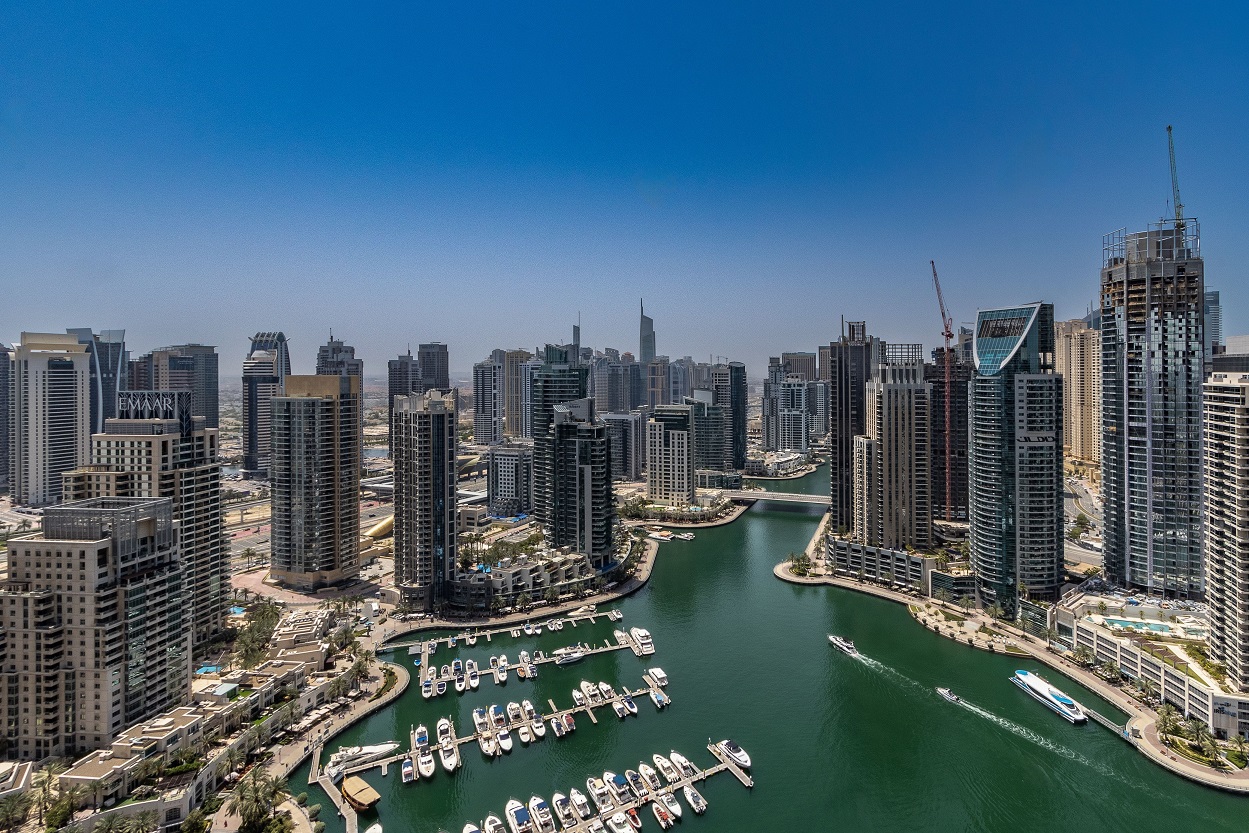
Photo credits: Featured image — Nelemson G / Pexels; Louis Harding portrait — Knight Frank.