UAE–Türkiye Trade Beyond the Headlines: Where the Next Commercial Opportunities Are Emerging
By Shabaan Abdelfattah
From automotive logistics to AI infrastructure and clean energy, growing economic ties are opening new opportunities for businesses. Turning them into lasting commercial value, however, will depend on execution, financing and market demand.
Non-oil trade between the UAE and Türkiye exceeded US$45.2 billion in 2025, up 15.5% year on year, WAM reported. The figure reflects the rapid expansion of a commercial relationship that has gained momentum since the two countries implemented their Comprehensive Economic Partnership Agreement (CEPA) in September 2023. [1]
Yet rising trade volumes tell only part of the story. For businesses, the more important question is where this expanding relationship can generate sustainable revenues, new supply chains and commercially viable investments.
Three sectors offer particularly useful answers: logistics and automotive trade, digital infrastructure, and clean energy. Each presents opportunities at a different stage of development, with distinct requirements for turning commercial potential into profitable activity.
Logistics: Turning Trade Connections into Operating Businesses
Logistics provides one of the clearest examples of UAE–Türkiye economic cooperation moving beyond agreements.
In February 2025, AD Ports Group announced that Noatum Maritime had established United Global Ro-Ro with Turkish company Erkport. Noatum holds a 60% stake in the venture, while Erkport owns the remaining 40%. [2]
The partnership moved into operations within months. In April 2025, its LNG-powered vehicle carrier, UGR Al Samha, made its maiden call at Khalifa Port. The vessel can transport more than 7,000 car-equivalent units across 12 decks and serves a network focused on vehicle and heavy-cargo transportation across the Middle East, Asia and the Mediterranean, AD Ports Group said. [3]
The significance extends beyond a single shipping venture. Türkiye’s industrial and automotive capabilities complement the UAE’s ports, warehousing, distribution infrastructure and access to regional markets.
For vehicle distributors, freight forwarders, spare-parts suppliers and logistics operators, these complementary strengths could support business models built around sourcing, storage, regional distribution and after-sales services.
The opportunity is not limited to bilateral shipments.
In June 2026, AD Ports Group launched a weekly shipping service connecting Khalifa Port with Iraq’s Umm Qasr Port, strengthening regional trade links and wider connectivity with Türkiye and Europe. Although this is not a direct UAE–Türkiye shipping route, it illustrates the broader logistics network through which companies can reach multiple markets. [4]
What makes these opportunities commercially relevant is the availability of operating infrastructure, established industrial suppliers and regional distribution networks. Companies can build on existing facilities rather than waiting for entirely new transport systems.
Profitability, however, will still depend on shipment volumes, freight costs, customs procedures and delivery reliability. Businesses will need to assess cargo flows and establish reliable logistics partnerships before committing to major expansion.
The strongest prospects may emerge where Turkish manufacturing and UAE distribution capabilities combine to serve markets beyond the two countries.
Digital Infrastructure: Opportunities Beyond the Data Centre
Digital infrastructure offers a different kind of commercial opportunity, driven by investment in computing capacity, cloud services and artificial intelligence.
One significant development came on 30 April 2025, when Khazna Data Centers announced plans to build an AI-capable data centre in Ankara’s Başkent Organized Industrial Zone, with potential capacity of up to 100MW. The planned facility is intended to support high-density computing requirements and Türkiye’s expanding AI ecosystem. [5]
The project reflects growing interest in connecting Emirati digital-infrastructure investment with Türkiye’s technology sector and domestic market.
Its status, however, should be interpreted carefully. Khazna’s April 2025 announcement described plans to build the facility after securing a site. In the absence of a newer primary-source update establishing its construction or operating status, the project is best viewed as an announced investment opportunity rather than operating infrastructure. [5]
Even at that stage, large data-centre developments can generate potential business opportunities beyond the physical building.
Engineering firms, electrical-equipment suppliers, cooling specialists, cybersecurity providers and network operators can participate in the services required to develop and eventually operate such facilities.
For Turkish technology companies, partnerships with UAE investors could also create opportunities in enterprise software, cloud solutions and specialised technical services. UAE-based firms, meanwhile, may find opportunities in technology integration, infrastructure management and digital services tailored to Turkish businesses.
The commercial case ultimately depends on demand. Data centres require reliable electricity and connectivity, significant capital expenditure and customers willing to commit to computing capacity. Data-protection and cross-border data requirements can also shape project economics.
For smaller businesses, supplying specialised services to established technology operators may therefore offer a more accessible route into this market than investing directly in capital-intensive infrastructure.
The emerging opportunity is not simply the construction of data centres, but the commercial and technical ecosystem required to support them.
Clean Energy: A Prospective Market Opportunity
Clean energy offers another potential area in which UAE investment capabilities and Turkish industrial strengths could reinforce one another, although much of the bilateral opportunity remains prospective.
In 2023, Türkiye and the UAE established a strategic energy cooperation framework covering a portfolio of potential projects valued at US$29.7 billion. Türkiye’s Ministry of Energy and Natural Resources identified renewables, including offshore wind and solar, and clean hydrogen among the areas under consideration; WAM’s account of the agreements also included green hydrogen and ammonia. The figure represents a framework for potential projects rather than US$29.7 billion of completed investment. [6] [7]
Türkiye’s domestic energy market nevertheless provides a substantial foundation for future investment.
By the end of September 2026, the country’s installed electricity capacity had reached 127,355MW. Solar accounted for 22.2% of capacity and wind 12.2%, meaning the two sources together represented more than one-third of the national total. The Ministry of Energy and Natural Resources also projects electricity consumption of 455.3TWh in 2030 and 510.5TWh in 2035. [8]
For UAE companies, this creates prospective opportunities in renewable-energy development, equipment supply, energy storage, industrial efficiency and related engineering services.
The UAE also brings international project-development and financing experience. In January 2026, Masdar reported that its global renewable-energy portfolio had reached 65GW, including 45GW operational, under construction or committed, as it works towards a 100GW target by 2030. [9]
The opportunity should nevertheless be assessed project by project. Large renewable developments must secure suitable sites, grid connections, regulatory approvals, financing and viable revenue arrangements before becoming bankable.
Smaller-scale segments may provide more immediate openings. Industrial energy-efficiency services, factory-level solar installations, energy-management systems, battery solutions and equipment maintenance can create opportunities without requiring companies to develop a large power plant.
There is also a wider regional dimension. Turkish manufacturers and engineering firms could seek partnerships with UAE energy companies operating across the Middle East, Africa, Central Asia and other markets.
The longer-term opportunity may therefore lie not only in Emirati investment in Türkiye, but in combining Emirati investment platforms with Turkish engineering and manufacturing capabilities to compete for projects in third countries.
From Growing Trade to Sustainable Commercial Value
The UAE–Türkiye Comprehensive Economic Partnership Agreement provides an important foundation for this next stage of cooperation.
Signed in March 2023 and implemented on 1 September 2023, the agreement brought 80% of tariff lines within the scope of concessions, while also including provisions intended to improve market access and reduce trade barriers, Türkiye’s Ministry of Trade states. [10]
For exporters, however, preferential access does not eliminate every commercial obstacle. Benefits depend on product classifications, rules of origin, regulatory compliance and the economics of serving each market.
That distinction is visible across all three sectors.
Logistics already offers opportunities built around operating assets and regional distribution networks.
Digital infrastructure presents opportunities linked to announced projects whose commercial impact will depend on development and customer demand.
Clean energy offers substantial prospective potential, but individual projects must still satisfy financing, regulatory and operational requirements before expected returns can be realised.
Across these sectors, the common lesson is that stronger diplomatic relations and expanding trade can create favourable conditions, but they cannot substitute for viable business models.
Companies seeking to benefit from UAE–Türkiye cooperation will need to identify genuine customer demand, evaluate costs and regulatory exposure, and select partnerships that provide practical advantages in market access, technology or distribution.
The most promising opportunities may therefore not be confined to what the UAE and Türkiye sell to each other.
They may increasingly emerge from what the two economies can finance, manufacture, transport and deliver together to other markets.
That is where the relationship’s next stage of commercial value will be determined: not by the size of new agreements, but by the businesses and projects that succeed in turning economic cooperation into sustainable returns.
About the author
Shabaan Abdelfattah is a senior strategic research and media intelligence specialist based in Abu Dhabi, with more than a decade of experience in political research, media analysis, OSINT and regional affairs. He previously worked at the Emirates Center for Strategic Studies and Research, producing analytical, early-warning and decision-support products for institutional audiences and senior decision-makers. His work focuses on Türkiye, the Gulf and the wider Middle East, with particular expertise in narrative and reputation analysis, geopolitical risk, media intelligence, multilingual monitoring, and translating complex regional developments into clear, actionable insights for professional and policy audiences.
Sources
- WAM — UAE–Türkiye trade and investment partnership (8 May 2026)
- AD Ports Group — Noatum Maritime and Erkport joint venture (24 February 2025)
- AD Ports Group — UGR Al Samha maiden call (11 April 2025)
- AD Ports Group — Khalifa Port–Umm Qasr logistics service (19 June 2026)
- Khazna — Ankara data-centre announcement (30 April 2025)
- Türkiye Ministry of Energy — Strategic partnership framework (25 August 2023)
- WAM — UAE–Türkiye agreements, including green hydrogen and ammonia (19 July 2023)
- Türkiye Ministry of Energy — Electricity statistics (updated 21 October 2026)
- Masdar — 65GW renewable-energy portfolio (13 January 2026)
- Türkiye Ministry of Trade — CEPA entry into force (1 September 2023)
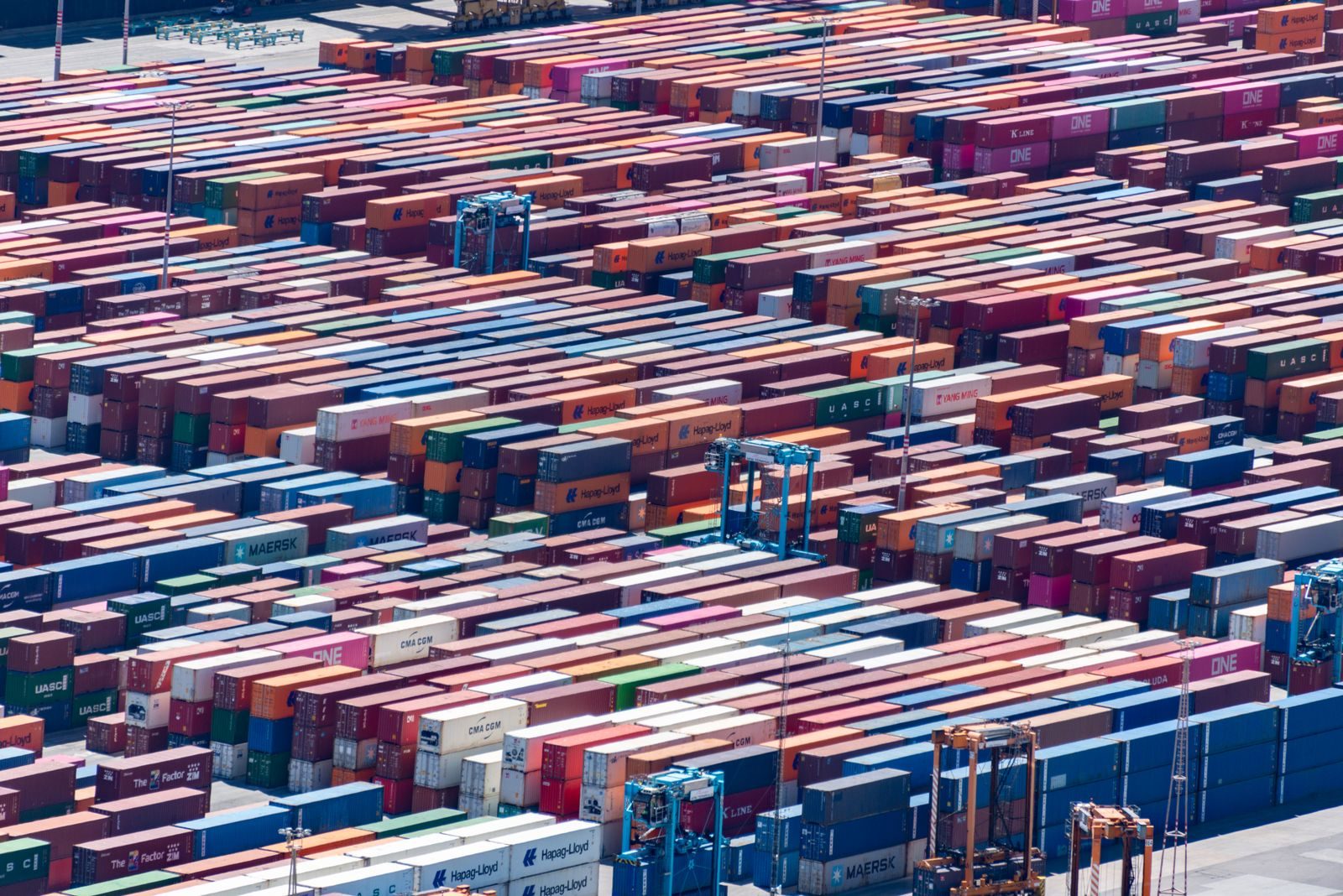
Photo credit: Diego F. Parra / Pexels. Illustrative image of shipping containers at a port.