Global Export Outlook 2026: 75% of Firms Still Expect Growth Despite Middle East Conflict
In the February–March 2026 Allianz Trade Global Survey, 75% of surveyed exporters expected their exports to grow in 2026 despite the Middle East conflict. The survey covered 6,000 companies across 13 markets and was conducted in two waves.
The report, published on 8 April 2026, describes expectations and responses recorded during that survey period. Its findings should be read in that historical context, rather than as an update on subsequent developments.
Exporters expected growth but anticipated higher payment risks
The survey identified geopolitical and political risks as a concern for 65% of respondents, followed by supply-related risks, including supplier failures and input shortages (57%), and supply-chain complexity and concentration (45%).
In the accompanying press release, Allianz Trade CEO Aylin Somersan Coqui described export confidence as fragile and warned that it could weaken if the conflict continued. That was an assessment of the outlook at the time of the survey.
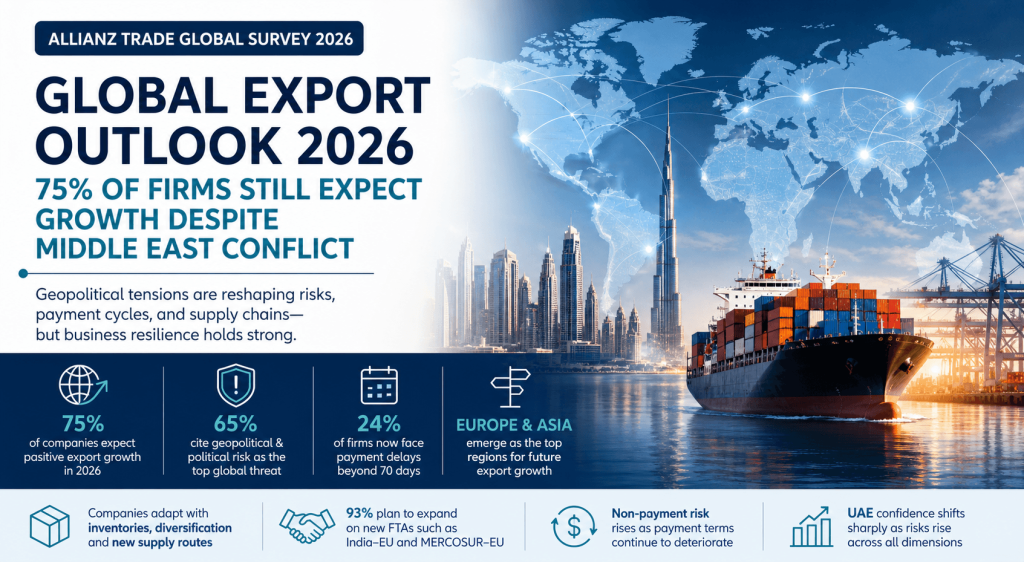
The April report recorded 7% of companies receiving payment within 30 days, down 4 percentage points from the 2025 survey. The share waiting more than 70 days was 24%, up 7 percentage points from 2025.
Separately, 43% expected export payment terms to lengthen over the following six to 12 months, up 5 percentage points from the pre-conflict wave. The share expecting higher export non-payment risk reached 40%, up 6 percentage points. These figures describe respondents’ expectations, not measured increases in defaults. Pharmaceutical, construction and computer/telecom respondents reported comparatively high concern about non-payment risk.

UAE outlook in the February–March 2026 survey
Allianz Trade’s regional press release reported that the share of surveyed UAE companies expecting higher export non-payment risk rose from 23% before the conflict to 42.6% in the subsequent survey wave, an increase of 19.6 percentage points. The public report presents the latter figure rounded to 43%. This was a change in expectations for the following six to 12 months, not a measured increase in unpaid invoices.
In commentary accompanying the release, Allianz Trade Senior Economist Lluís Dalmau Taulés interpreted the divergent reshoring responses as a tension between diversification and caution over new investment. This was an interpretation of survey responses, rather than evidence of completed production relocations or a prediction of subsequent government policy.
Companies reported inventory building and diversification
Respondents reported implementing mitigation strategies following the trade disruption that began in 2025. The most common measures were inventory building and diversification into new markets (64% each), sourcing from new suppliers (63%) and rerouting through third markets (57%). These were actions reported by the time of the February–March 2026 survey.
In the accompanying release, Allianz Trade’s Head of Corporate Research, Ano Kuhanathan, reported that 50% of respondents were seeking alternative shipping routes or carriers and 50% were working with customs brokers to expedite clearance. Adjusting delivery schedules was reported by 48%, while changes to Incoterms were reported by 36%.
He interpreted these February–March 2026 responses as showing that operational adjustments were moving faster than contractual changes.
According to the release, 72% of surveyed exporters expected the global reshoring trend to continue at least at its existing pace. This was an expectation about the trend, not a count of companies that had moved production.
Reported constraints included access to suitable domestic suppliers (around 83%), production costs (67%) and insufficient tax incentives or subsidies (61%). Allianz Trade interpreted these responses as evidence that supply-chain resilience was influencing investment priorities.
Europe and Asia featured in exporters’ growth plans
Only 13% of surveyed firms considered the US a growth market. Allianz Trade linked the weaker interest in the US market to the trade war. Interest in Europe as an export destination increased, with Singaporean and US exporters recording rises of 10 and 9 percentage points respectively compared with 2025. Asia also featured prominently in respondents’ investment plans.
About a quarter of surveyed firms planned to increase their presence in China, substantially fewer than in the 2025 survey. Allianz Trade’s accompanying release also reported that 10% were planning to exit. These were investment intentions recorded in early 2026, rather than completed investment flows.
Allianz Trade’s release reported that 93% of surveyed firms planned to use new trade agreements to support expansion. Its Head of Economic Research, Ana Boata, identified licensing and certification requirements as continuing barriers to turning market access into export growth.
The agreements discussed in the April report included EU–India and EU–Mercosur. For EU–India, the 27 January 2026 summit outcome recorded the conclusion of trade negotiations. The survey findings should not be read as confirmation that all the agreements discussed had already entered into force.
Other findings in Allianz Trade’s April 2026 report
- US tariffs: 80% of respondents reported adjusting trade and supply-chain routes since the 2025 tariff shock; 43% expected a net negative impact from the trade war in 2026.
- Investment: Allianz Trade interpreted respondents’ plans as treating the conflict-related input-cost shock as temporary.
- Foreign exchange: The study highlighted forecasting and risk management, financial hedging, and matching payments and receipts as common responses.
- Sustainability: The share of respondents agreeing that their companies were pursuing sustainability actions fell from 84% in 2025 to 62% in 2026, a decline of 22 percentage points. This measured survey responses, not ESG spending.
- AI: The authors identified uncertainty over returns on investment as a barrier and reported weaker expectations for AI’s contribution to export growth after the conflict began.
About Allianz Trade
Allianz Trade provides trade credit insurance and related risk-management services. It produced the survey discussed in this article.
Photo credit: Lluis Dalmau, Senior Economist at Allianz Trade.
Sources
- Allianz Trade Global Survey 2026 — full report, 8 April 2026 (PDF)
- Allianz Trade’s April 2026 research summary
- Allianz Trade’s accompanying global press release
The UAE figures quoted to one decimal place are attributed to the regional press release supplied to the publication.
Editor’s note (29 October 2026): This article was originally published on 2 May 2026 and covers a survey conducted in February–March 2026, with the report released on 8 April. The wording and source references have been clarified to distinguish survey findings from commentary and to correct the comparison periods and sustainability figure. These edits do not introduce a new survey wave.